|
|
|
|
|
|
|
Rings >> Mantra Ring
|
|
|
|
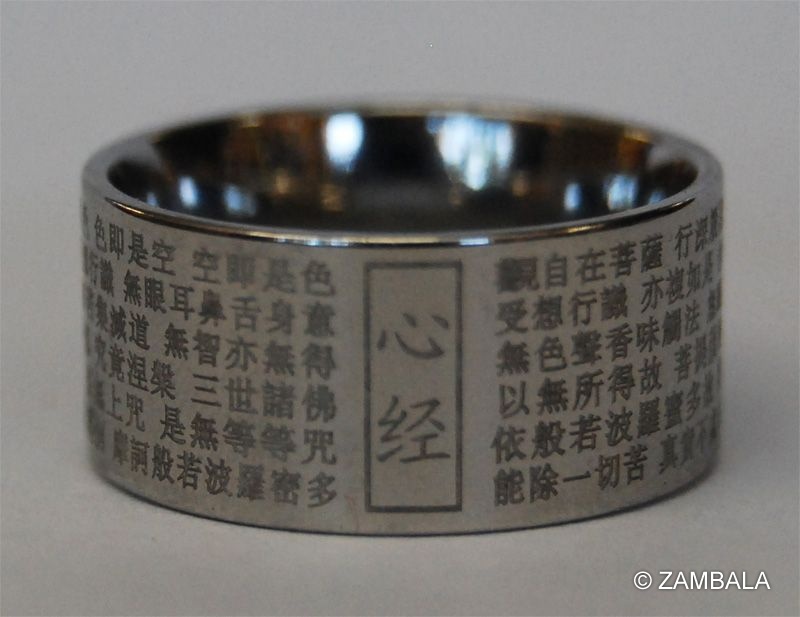
| Heart Sutra Ring (silver color) |
|
|
|
|
|
Sku#:3062B
|
|
|
|
|
|
|
 |
|
Please contact us to verify availability. 1-626-354-6228
Email: zambalallc@gmail.com
America area customers can view on this website first.
https://FlyingMystics.org/ |
|
|
|
|
|
|
Material: Stainless steel. Thick ring design. Heart Sutra
Size: (Subject to availability)
Description:
Benefits of Reciting the Heart Sutra for Practitioners
The Heart Sutra (also known as the Prajnaparamita Heart Sutra) is the essence of Mahayana Buddhist Prajnaparamita classics. In just 260 characters, it condenses the core teachings of Prajnaparamita—emptiness and wisdom. Reciting the Heart Sutra is a daily practice for many Buddhists, with benefits covering a wide range of body, mind, and spirit, benefiting both beginners and experienced practitioners. The following is a summary of the main benefits (based on Buddhist scriptures and practice traditions):
- **Opening Wisdom and Understanding Emptiness:** The core of the Heart Sutra is "Seeing that the five aggregates are empty, thus transcending all suffering." Recitation helps practitioners gradually realize the lack of inherent existence (emptiness) in all phenomena, breaking through attachment and ignorance, and increasing Prajna wisdom. Experienced practitioners can use this to enter into reality, let go of delusions, and truly "transcend all suffering."
- **Eliminating Karmic Obstacles and Overcoming Afflictions:** Regular recitation can overcome the three obstacles (afflictions, karma, and retribution), removing greed, anger, and ignorance, and eradicating sins. Traditional records indicate that recitation can break through the ten evil deeds and the five heinous crimes, dispelling demonic obstacles and negative energy.
- **Peace of Mind and Tranquility:** The process of recitation can stabilize the mind, provide breathing space, and reduce stress and anxiety. Many people experience peace of mind, improved sleep, and even enhanced memory and mental resilience.
- **Accumulating Blessings and Immeasurable Merit:** Reciting scriptures is an act of increasing blessings and wisdom, planting the seeds of Bodhi, and forming good karma. Traditionally, it is believed that prolonged recitation can "fulfill all wishes," aiding in academic success, career advancement, marriage, and the fulfillment of desires.
- **Protection and Practical Benefits:** Historically, when the monk Xuanzang traveled west to obtain Buddhist scriptures, he recited the Heart Sutra to overcome dangers. Modern practitioners often feel the blessings of Vajra protectors, warding off evil and disasters, improving interpersonal relationships, and enhancing their fortune.
The key to reciting the Heart Sutra lies in sincerity; it can be recited aloud or silently. Reciting it several times daily, or combining it with the mantra (Gate Gate Paragate Parasamgate Bodhi Svaha) 21 times, will yield even better results. Beginners should start by understanding the meaning of the sutra; over time, they will naturally experience its merits.
The Meaning and Influence of the Heart Sutra in Tibetan Buddhism
In Tibetan Buddhism (Vinaya-Pali Buddhism), the Heart Sutra is considered the "heart essence" (essence) of Prajnaparamita, holding an extremely high position. Its full title is the *Heart Sutra of the Holy Mother Prajnaparamita*, personifying Prajnaparamita as "Prajnaparamita," regarded as the mother of wisdom and the mother of all Buddhas.
- **Meaning**:
- **Explanatory Meaning**: It elucidates emptiness (śūnyatā) and dependent origination, teaching that all phenomena are without inherent existence, helping practitioners transcend duality and realize true reality.
- **Implicit Meaning:** It implicitly contains the five paths (path of accumulation, path of application, path of seeing, path of cultivation, and path of no more learning) and the ten bhumis (stages of bodhisattva practice), guiding the complete path from ordinary being to Buddhahood.
- Tibetan Buddhism uses a longer version (the extensive version), including an introductory section, a concluding section, and a question-and-answer section, emphasizing that Prajnaparamita is a secret mantra (dharani) with the hidden meaning of dispelling demons and removing obstacles.
- **Influence:**
- **Core of Daily Practice:** All major schools, including Gelug, Sakya, Kagyu, and Nyingma, incorporate it into their morning and evening recitations and chanting collections. It is frequently recited in monasteries and considered an indispensable scripture, used in Buddhist ceremonies such as deliverance, consecration, and animal release, to ensure the fulfillment of wishes and the removal of obstacles.
- **Tradition for Removing Obstacles:** On the 29th day of the 11th month of the Tibetan calendar (the day Yama, the King of Hell, counts the days until death), monasteries and devotees widely recite the Heart Sutra to dispel obstacles to longevity and calamities, praying for auspiciousness in the coming year.
- **Teaching Foundations:** Tibetan Buddhism considers the Prajnaparamita Sutras as its core texts, with the Heart Sutra being its essence. Masters like Atisha widely propagated the Prajnaparamita, influencing lineages such as the Kadampa school. Practitioners use the Heart Sutra to cultivate emptiness, integrating Madhyamaka and Yogacara views.
- **Tantric Applications:** It is regarded as a tantric text, accompanied by dokpa rituals, used to ward off negative forces.
In short, in Tibetan Buddhism, the Heart Sutra is not only a teaching of wisdom but also a practical tool and a symbol of deity blessings, profoundly influencing monastic and lay practice and cultural traditions. Whether in Han or Tibetan Buddhism, reciting the Heart Sutra brings profound benefits; it is recommended to practice it with reverence.
|
|
|
 |
|
|
|